
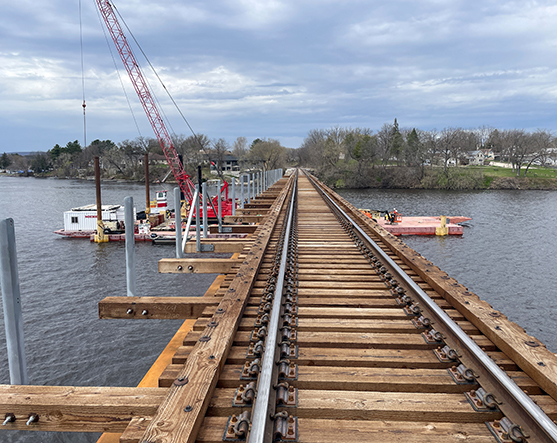
Building A Bridge for the Future
The Wisconsin & Southern Railroad’s (WSOR) Merrimac bridge traces its history back more than 150 years. It first carried train traffic in 1874, and its last major upgrades were in 1898, 1903, and 1930. The WSOR and its partners recently completed a 10-year, $26-million, three-phase project to bring this aging infrastructure into the 21st century.
The bridge crosses Lake Wisconsin, which separates Columbia County on the south side from Sauk County, the town of Merrimac, and the rest of the Reedsburg Subdivision on the north. It measures 1,730 feet and contains 22 spans. Prior to the state purchasing the line in 2014, the bridge was a bottleneck due to deferred maintenance by the previous owner. Slow orders and a 263,000-lb. weight limit reduced efficiency, customers’ ability to ship, and safety. The WSOR began operating the subdivision, and in 2016, started working with the Wisconsin Department of Transportation (WisDOT) to upgrade the bridge.
“We had more than a dozen customers between Merrimac and Reedsburg that approached us about making the bridge capable of handling the industry-standard 286,000-lb. railcars,” said Ken Lucht, assistant vice president, Government & Industry Relations. “Urgent repairs to strengthen Span 2 were completed in 2018, while we started working on long-term upgrades to address the customers’ needs.”
In 2021, Phase 2 increased the capacity of seven spans. In the meantime, a coalition of the WSOR, WisDOT, Wisconsin River Rail Transit Commission (WRRTC), and Sauk County each committed funding while working to secure a $6.75 million U.S Department of Transportation Nationally Significant Multimodal Freight and Highways Project, or INFRA, grant for Phase 3. It began in 2023 and included 1,730 feet of new bridge deck, replacing 13 spans, underwater encasement of three piers, concrete rehabilitation of 18 more, installing heavier rail, and rebuilding the approaches at either side.
Phase 3 was completed in December 2025. The Merrimac bridge opens new opportunities for customers to ship 286k cars at 25 miles per hour to other parts of the WSOR and interchanges with all Class I railroads. In late April, representatives from all the funding groups and customers gathered for a ribbon cutting. Federal Railroad Administration Senior Policy Advisor Rusty Roberts, WisDOT Secretary Kristina Boardman, and Chairman of WRRTC Marty Krueger were among the attendees.
“Our customers came to us with a concern, and we found a way to address it,” Lucht said. “It shows our commitment to Watco’s Foundation Principles, the WSOR’s dedication to our customers, and what we can accomplish when we collaborate with them and with local, state, and federal agencies. We’re not building for now. We’ve built something that will support this area’s growth for the next 50 or 60 years.”