
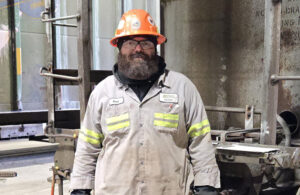
Off-Duty Team Member Spots a Safety Issue
The things we do in our cars to pass time while stopped at a railroad crossing might include looking at our phones. Counting the train cars. Admiring the railcar graffiti.
They might not include noticing one railcar wheel that was not turning. Unless you’re Neal Higginbotham, railcar repairman for the South Kansas & Oklahoma Railroad (SKOL). Higginbotham was on vacation earlier this year, and while stopped at a Kansas highway grade crossing to wait for a 130-car manifest train to pass, he spotted a problem.
Hearing about this off-duty observation was an out-of-the-ordinary moment for SKOL Assistant General Manager Greg Ferguson. “I was surprised,” he said. “What’re the chances, right? Neal actually works in the car department, so he’s more likely to notice that on a car rolling by than someone else, but still …”
As soon as he saw the issue, Higginbotham texted his supervisor, Railcar Foreman Aaron Day. He said, ‘I think the brakes are locked up,’” Day recalled, “and he told me the car number and the wheel number.” Day notified the trainmaster and sent two people over to inspect the car, which had been set out in the nearby SKOL Cherryvale Yard. “They did an air test on it, and they found the emergency valve was defective.” Each railcar air brake system has a service valve and an emergency valve. The service valve controls normal, gradual braking. The emergency valve normally activates only with a sudden, rapid drop in brake pipe pressure – for example, when an engineer initiates emergency braking.
When operating properly, the system is failsafe; a faulty valve would automatically apply the brakes to all wheels. For some reason, only wheelset No. 3 was affected. “The angularity of the rigging along with condition of the brake shoes could have been a factor in that,” said Day. “All four wheels probably had pressure on them, but the brake shoes might have been a lot newer on the No. 3 wheelset.”
Fortunately, Higginbotham caught the problem before it became a larger concern. A locked wheel eventually develops a flat spot from friction as it slides on the track. A damaged wheel would mean purchasing and replacing a wheelset at a cost of about $1,000. “You can’t just get one (wheel),” said Day. “You have to replace the entire wheel set: the axle, both wheels, both bearings.”
A locked wheel also creates the potential for a fire. That’s because a wheel that’s not rolling can spark, and dead grass next to the track can catch fire. There’s also the danger of a derailment from loss of proper guidance by the rails, excessive lateral forces on curves, or other complications.
Even though Higginbotham works in railcar repair, his awareness level while vacationing was impressive.
“I’m always looking at the cars when they go by,” said Day. “I spot things, too, but never anything like he did. That was a good catch on his part.”