
Teams Collaborate to Keep Terminal Service Going
A new barge-mounted crane on order for Watco’s Port Arthur Dedicated Terminal in Texas was due to arrive in about three months when the existing crane had to be removed from service due to a mechanical issue. In a display of cross-functional collaboration under pressure, team members from across Watco worked diligently to help minimize any delay in discharging ships for the customer.
The crane went down September 20, and Watco was able to resume operations three days later.
“We pulled together members of various support teams to invent a solution to get the customer served,” said Vice President of Operations Nathan Holmes. One part of that solution was finding a way to unload the customer’s dry bulk cargo, and they quickly determined they’d need help from the Watco Greens Port terminal in Houston. “In order to unload the ship,” Holmes said, “we needed to use the ship’s cranes, which is something the Greens Port team does all the time, but the Port Arthur team has never done before.”
Port Superintendent Mike Lutz of Greens Port sent “two of our top winchmen,” Enrique Ortiz and Juan H. Hernandez, to Port Authur. Their experience operating ship’s gears – the shipboard cranes and other cargo-handling equipment built into vessels – was invaluable. One worked the day shift, the other the night shift. Lutz also sent Crane Operators Servando Mendez and William Martinez to assist with training and evaluation.
Those tasks fell primarily to Safety Manager John Banks and Training Specialists Walter Punteney and Jose Rodriguez. Their roles were to get the Port Arthur team familiarized with the equipment and how to use it safely, facilitate hands-on skills training, and assess skills. Port Arthur Operators Halston Ryan, Jerel Taylor, Sidney Malbrough, and Jorge Govea, Supervisor Trysten Hoke, and Terminal Manager EL Ryan learned the ship’s gear. “They did very well with the equipment,” said Banks, “and we were able to keep continuing the operation moving forward.”
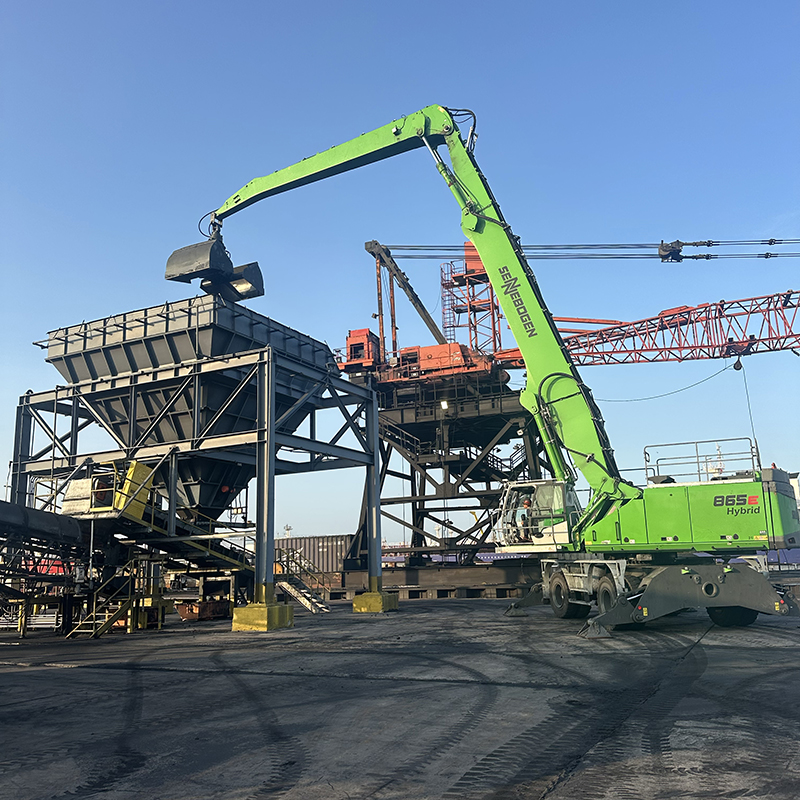
Moving forward is something that could not have happened without arranging for a barge. Senior Vice President of MID-Ship Logistics Colin Schneider secured the barge and explained it was needed because “the ship’s cranes don’t extend far enough to reach the dock, so they needed to be able to land the material into a barge that sits between the ship and the dock. Then they use a Sennebogen (material handler) to unload from the barge to the dock.”
Chartering the barge required a charter agreement. Schneider worked with Senior Vice President of Risk Management and Procurement Amanda Simpson and Senior Corporate Counsel Zach Baden to hastily develop a contract for the long-term lease of a barge. “It’s not something that typically is put together in 24 hours, and we did it in less,” said Schneider.
Having team members from Greens Port as operators and training the Port Arthur team at the same time proved a solid strategy. “That way, I don’t have to borrow someone going forward,” said Ryan. “We keep it in house and can do it ourselves.”
Holmes concurred. “This method that we came up with a few weeks ago is what we are going to have to do for the next few months. Getting people trained so that the Port Arthur team is self-sustainable and not completely reliant on people willing to travel and be away from home for a week at a time was important. And we were able to get that all done.
“It was just a really great example of all the various groups within Watco coming together to get a customer served with a very quick response.”