
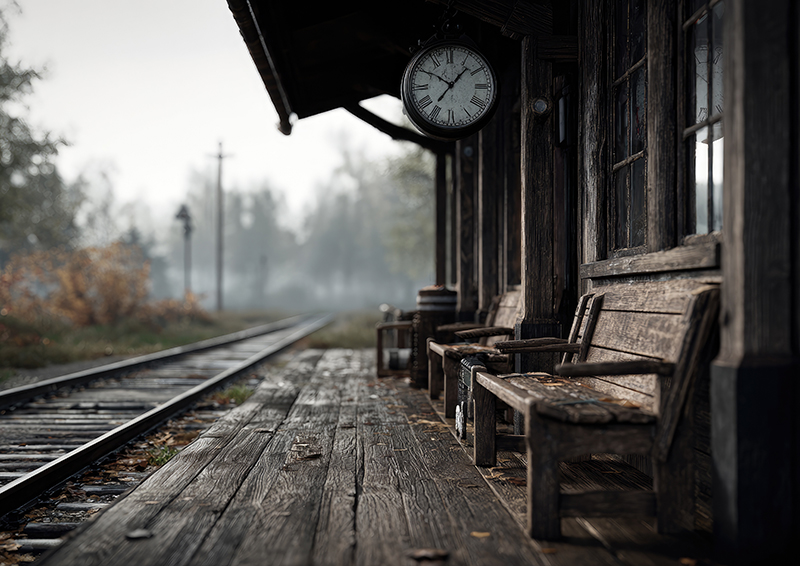
Train Time: How Railroads Helped Set Our Clocks
Most the of U.S. will move its clocks back an hour on November 1, and it will happen on the hour at 2:00 a.m. We know exactly what time the change will happen in our time zone, but that wasn’t always the case. By enabling the quick movement of people and good across the country, railroads played a large role in standardizing time.
They say, “time is relative,” but that was the reality for most of the U.S. until 1918. Before that, noon was whenever the sun was directly overhead. Prior to the Standard Time Act of 1918, when it was noon in Chicago, it was 11:27 a.m. in Omaha, Nebraska. Today, Chicago and Omaha share Central Standard Time, which means both cities’ clocks strike noon at the same time.
Prior to the federal law, a train could leave a station, travel for 20 minutes, and arrive 25 minutes later. To add to the confusion, railway stations had two clocks. One displayed the local time, and the other showed the railroad time. A train could depart at 12:15 local time and 12:20 railroad time, which was actually the same time. This made it difficult for passengers and shippers to know when trains were moving. It also caused safety issues.
Timing had to be precise and train crews remained vigilant to avoid collisions. If a track should be clear at 3:30 p.m., whose 3:30 p.m. was that referring to?
The idea of standardized time started in the 1880s in the United Kingdom, when they faced confusion around railroad schedules. Their solution shaped how the U.S. handles time and eventually spread to most of the world.
Today’s time zone boundaries have changed over the years, and there is endless debate about Daylight Saving Time, but regardless of where you are, minutes and seconds are the same. In today’s virtual world, a person in New York hosting an online meeting at 2:30 p.m. Eastern time knows that a participant in Los Angeles will join at 11:30 a.m. Pacific time. That’s largely thanks to railroads.