
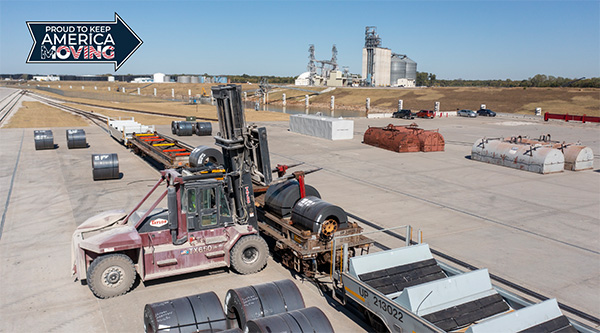
Watco Keeps America’s Steel Moving
Steel is a big deal. It’s been called the backbone of American industry and the heart of the United States’ infrastructure. Few if any materials have been a larger part of building the nation over the last 250 years. And Watco plays an important role in the supply chain when it comes to this strong, versatile metal.
Every day across the country, Watco moves, transloads, and stores both finished steel products and raw materials. As a company, Watco moves around 17 million tons of steel and metal products annually.
Our company first served a steel mill starting in 2003, when we began operating the Pennsylvania Southwestern Railroad. Today, it’s hard to grasp all the modes and locations where Watco and steel come together, but here’s a smattering.
Watco has multiple terminals and ports in one area known for steel: the Industrial Heartland, generally between Illinois and Pennsylvania. At least a dozen facilities in and around this important corridor help connect mills, processors, and end markets, handling storage and processing of raw material inputs and finished steel products. We have teams dedicated to individual customers at steel mill operations in Tennessee, West Virginia, Mississippi, Kentucky, and other locations. These sites feature services such as dock transloading, alloy and scrap handling, yard management, rail movements, and railcar offloading.
Another state that stands out for steel is Alabama, where the Alabama Southern Railroad and Guntersville Terminal are just some parts of our business tending to steel. Guntersville supplies pig iron to foundries and mills across the southeastern U.S. At Port Birmingham and on the Birmingham Terminal Railway, Watco handles one customer’s world-class tubular pipe for drilling oil. For other customers, it’s fencing, coils, plates, and more. The port recently opened a new warehouse designed specifically to handle cold-rolled steel coils. Steel is the main commodity at Decatur River Port, which is surrounded by mills, foundries, processors, and finishers. This location handles and stores coal, pig iron, and ferroalloys used in the steelmaking process as well as finished coils, plates, and beams.
In neighboring Mississippi, the Port of Amory handles coal that is dried into coke on site and shipped to Columbus (and also to Tuscaloosa, Alabama), where it is used in the refining process. The Mississippi
Southern Railroad (MSR) has recently taken on its first steel pipe projects, to support gas pipeline construction in the state. Last month, a Pennsylvania company began shipping what will amount to about 700 carloads to Louisville. That pipe is staged in a laydown yard in preparation for transloading (a first for the MSR). Also last month, an Arkansas company sent the first of six unit trains of pipe to Union.
Texas brings together several parts of the steel story, as our terminals there handle anything from raw materials to finished steel products. A few examples: In Houston at Watco Greens Port, we handle unit
trains of steel pipe coming from a mill in Ohio that are used in the oil and gas industry. We handle barges of various steel products such as coils, plates, and beams shipped from domestic mills for distribution to the Houston market. The Refugio Transload Terminal handles lime, added to molten metal as a cleaning agent, for domestic mills. And the Texas Coastal Bend Railroad handles imported pig iron that goes to a mill in south Texas.
At the Tulsa Port of Catoosa Marine Terminal in northeast Oklahoma, Watco operates the main dock. At this location, 90 to 95 percent of the commodity mix is steel: coils, plates, wire rods, rebar, and pipe. For some of their largest customers, the team frequently transloads coils from barges or railcars onto coil trucks bound for local and area metal processors and distributors, or they might warehouse them for customer pickup. Ultimately, these coils become components of products like utility poles and kitchen appliances. The team handles an average of seven to ten barges and 75 railcars a month.
Watco Logistics manages the movement of steel, providing a single point of coordination for domestic (and international) moves. For example, three Midwest-based teams regularly coordinate trucking to places all over the country for a top U.S. steel producer. For example, the team in Overland Park, Kansas, arranges for the company’s steel beams to travel from South Carolina to multiple states. The team in Joplin, Missouri, manages the movement of plates and coils from Alabama to various states. And Springdale, Arkansas, team members ensure that coils and over-dimensional plates make their way from states such as Kentucky, Alabama, and North Carolina to many regional and national destinations. End uses for these commodities are all types of structures, home appliances, and vehicles.
Watco’s MID-Ship Logistics manages a wide range of bulk and breakbulk steel commodities. Through its network of inland waterways, terminals, and logistics partners, MID-Ship coordinates the movement
of finished products and raw materials among vessels, barges, railroads, trucks, and end users. Its role extends beyond transportation coordination by arranging cargo handling, warehousing and inventory
management, and supply chain management solutions.
Demand for steel in the U.S. is expected to remain strong for years to come, fueled by infrastructure, construction, and industrial growth. Watco will be there to continue helping move the raw materials and finished products that make that growth possible.